

How to Perform Umrah Step by Step: Ihram, Tawaf, Sa'i and Halq
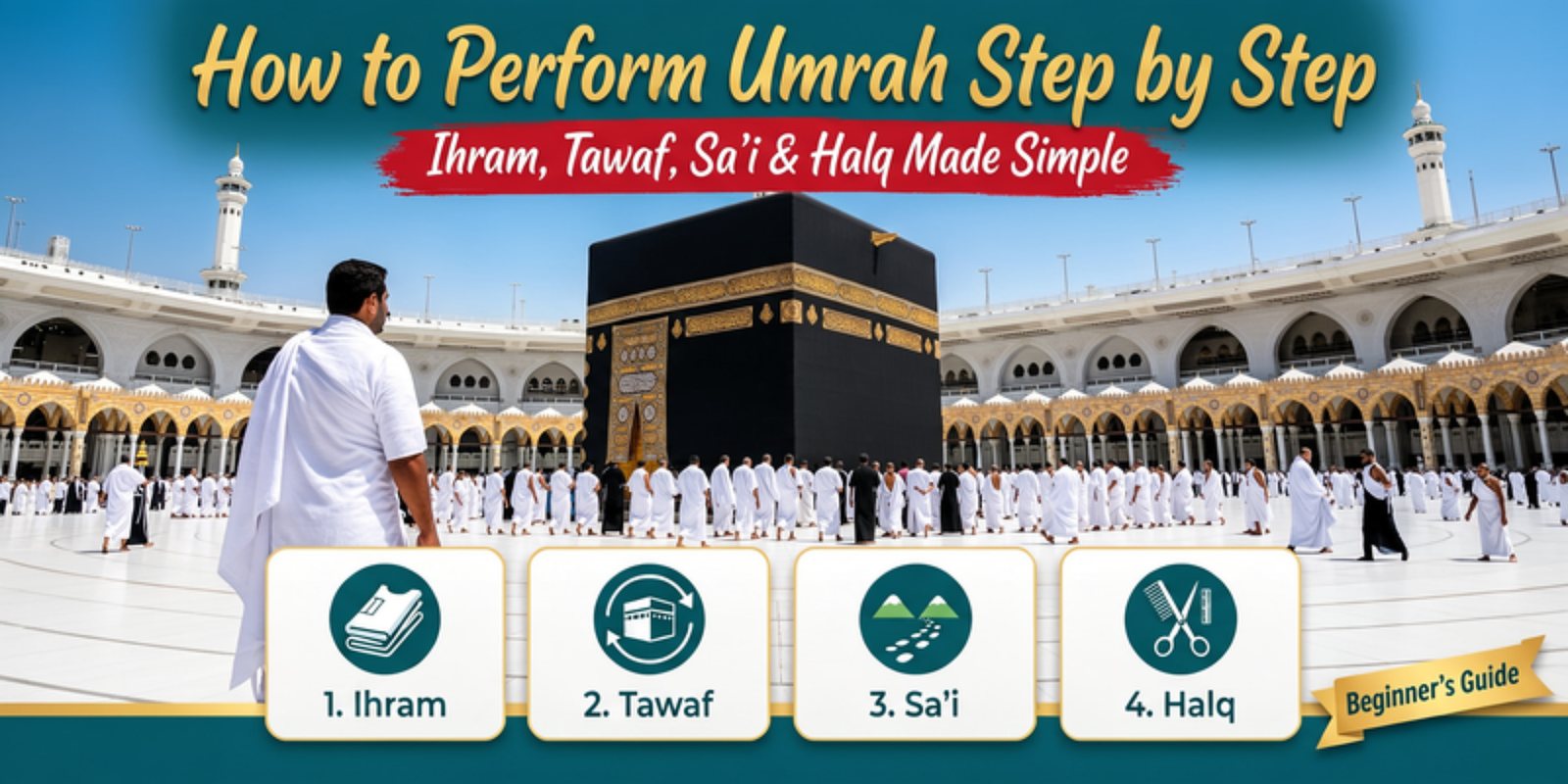
Quick answer: Umrah has four essential steps. First, enter the state of Ihram at or before the Miqat with the intention (niyyah) and the Talbiyah. Second, perform Tawaf: seven circuits around the Kaaba. Third, perform Sa'i: seven walks between Safa and Marwah. Finally, men shave the head (Halq) or trim the hair (Taqsir), and women trim a fingertip's length.
Umrah, the "lesser pilgrimage", can be performed at any time of year, and its core rituals take only a few hours. Even so, many first-time pilgrims worry about doing each step correctly. This guide explains how to perform Umrah step by step, in order, with practical tips for travellers from Pakistan. For fiqh questions specific to your school of thought, consult a qualified scholar.
What Is Umrah?
Umrah is a Sunnah act of worship performed at Masjid al-Haram in Makkah. It is made up of four parts: Ihram, Tawaf, Sa'i and Halq or Taqsir. Pilgrims usually combine it with a visit to Madinah and Masjid an-Nabawi, although the Madinah visit is not part of the Umrah rituals themselves. If you are still choosing a package, compare the Umrah Economy package and the premium Umrah package to see which hotel distance and services suit you.
Step 1: Enter Ihram at the Miqat
Ihram is both a sacred state and the clothing worn in it. You must enter Ihram before crossing the Miqat, the boundary where pilgrims start their Umrah. Pilgrims flying from Karachi, Lahore or Islamabad usually pass the Miqat in the air, so most change into Ihram before boarding or at the airport. Cabin crew often announce when the aircraft is approaching the Miqat.
How to enter Ihram:
- Take a bath (ghusl) and trim the nails beforehand.
- Men wear two unstitched white sheets. Women wear modest, everyday clothing and leave the face and hands uncovered.
- Pray two rak'ahs of Sunnah if it is not a disliked prayer time.
- Make the intention for Umrah and begin reciting the Talbiyah: *Labbaik Allahumma labbaik…*
Once you are in Ihram, certain actions are prohibited. These include using perfume, cutting hair or nails, hunting, arguing, and marital relations. Men must not cover their heads.
Step 2: Perform Tawaf Around the Kaaba
On arriving at Masjid al-Haram, enter with your right foot and recite the dua for entering the mosque. Stop the Talbiyah when you begin Tawaf.
How to perform Tawaf:
- Start at the Black Stone (Hajar al-Aswad) corner, marked by a green light on the wall.
- Face the Black Stone, raise your right hand and say *Bismillah, Allahu Akbar*. You do not need to touch or kiss it in crowds; pointing is enough.
- Walk anticlockwise around the Kaaba, keeping it on your left, for seven complete circuits.
- Men uncover the right shoulder (Idtiba) throughout this Tawaf, and walk briskly (Ramal) in the first three circuits if space allows.
- Between the Yemeni Corner and the Black Stone, recite *Rabbana atina fid-dunya hasanah…*
- After seven circuits, cover the shoulder and pray two rak'ahs behind Maqam Ibrahim, or anywhere in the mosque if it is crowded.
- Drink Zamzam water.
You need to be in a state of wudu for Tawaf. If you lose wudu, renew it and continue from where you stopped.
Step 3: Perform Sa'i Between Safa and Marwah
Sa'i commemorates Hajar (AS) running between the two hills in search of water for her son Ismail (AS). Today the route is an air-conditioned gallery inside the mosque, with lanes for wheelchair users.
How to perform Sa'i:
- Go to Mount Safa, face the Kaaba, and recite the verse and duas of Safa.
- Walk towards Marwah. That counts as one lap.
- Men jog lightly between the two green lights. Women walk at a normal pace.
- Walking from Marwah back to Safa counts as the second lap.
- Complete seven laps, finishing at Marwah.
Make plenty of personal dua, in any language, during each lap.
Step 4: Halq or Taqsir to Exit Ihram
The final step is cutting the hair. Men may shave the whole head (Halq), which is more rewarding, or trim the hair evenly all over (Taqsir). Women gather their hair and trim about a fingertip's length from the end. After this, the restrictions of Ihram are lifted and your Umrah is complete.
Umrah Steps at a Glance
| Step | Ritual | Where | Key point |
|---|---|---|---|
| 1 | Ihram | Before or at the Miqat | Intention + Talbiyah; avoid prohibited acts |
| 2 | Tawaf | Around the Kaaba | 7 circuits, start at the Black Stone, wudu required |
| 3 | Sa'i | Safa to Marwah | 7 laps, finish at Marwah |
| 4 | Halq / Taqsir | Any barber or in your room | Shave or trim to exit Ihram |
Common Mistakes First-Time Pilgrims Make
- Crossing the Miqat without being in Ihram.
- Counting the circuits wrongly. A small Tasbeeh counter helps.
- Starting Sa'i at Marwah instead of Safa.
- Cutting only a few strands of hair instead of trimming properly.
If you are visiting Madinah, note that a visit to the Rawdah in Masjid an-Nabawi needs a permit booked through the official Nusuk app, and time slots fill quickly. Many pilgrims also spend extra days on Ziyarat in Makkah and Madinah after completing their Umrah.
Plan Your Umrah with House of Polani
House of Polani is a Karachi-based travel company recognised with the Labaytum Award 2026, and we guide pilgrims from booking to return. Choose from our Umrah Economy Plus package or our other Umrah options. Our religious travel services cover visas, hotels near the Haram and Ziyarat. To get a personalised itinerary, send an Umrah enquiry or contact our Karachi team.
Frequently Asked Questions
How long does it take to perform Umrah?
The four rituals usually take three to six hours, depending on crowds and your pace. Travelling outside Ramadan and school holidays, or doing Tawaf late at night, usually makes the rituals faster and calmer.
Can women perform Umrah without a mahram?
Saudi Arabia currently allows eligible women to perform Umrah without a mahram in an approved group, but rules can change. Follow your scholars' guidance; our team can confirm current requirements.
Do I need wudu for Sa'i?
Wudu is required for Tawaf but only recommended for Sa'i. If your wudu breaks during Sa'i, you may continue and complete your laps.
What is the best time of year for Umrah?
Umrah can be performed all year except during the days of Hajj. Ramadan carries special reward but is the most crowded period. Read our guide to Ramadan Umrah 2027 if you are planning for the holy month.